

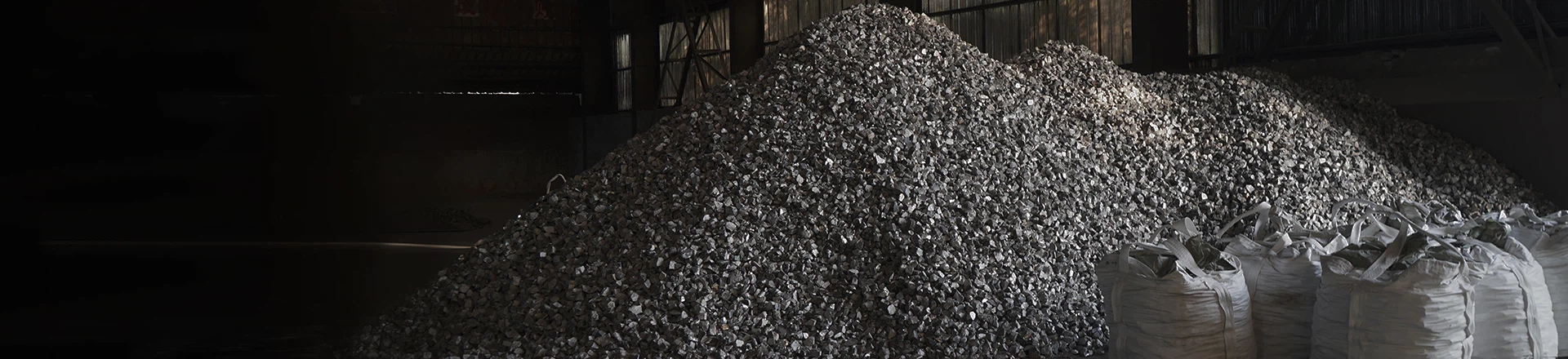

High Carbon Ferro Manganese (HCFeMn) is one of the most widely used ferroalloys in the world. High Carbon Ferro Manganese (HC FeMn) is a manganese alloy produced by direct smelting of manganese ore. It has a manganese content of 70-80 wt% and a carbon content of 6-7 wt%. It is the most used ferroalloy in terms of quantity, with its application mainly in steel production (90%) and the remaining 10% in foundry and welding.
Ferromanganese is produced by reducing manganese oxide in a blast furnace or electric furnace. This is a very flexible process and the slag can be reprocessed into ferromanganese silica, which in turn can be further refined into low and medium carbon ferromanganese. Ferromanganese was invented in 1860 as a method of adding manganese to the steelmaking process, with the advantage that the combination of iron and manganese oxide gives the ferromanganese alloy a lower melting point than pure manganese oxide. Standard ferromanganese (or high-carbon ferromanganese) is a commonly used alloy produced by reducing manganese ore in the presence of carbon. It usually contains 75% manganese and 7% carbon. The global production of high carbon ferromanganese was 4.4 million tons in 2019, with China being the world's largest producer accounting for 39% of the global total.


