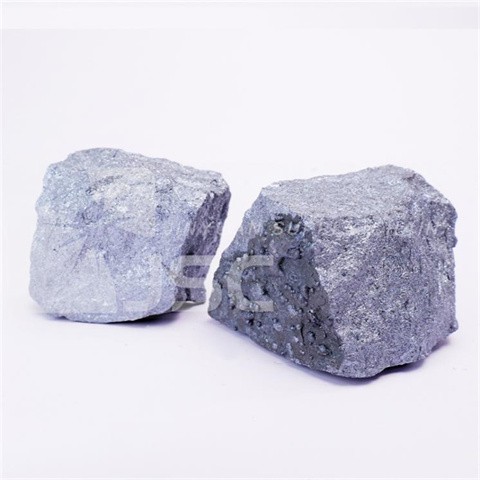

Commonly used deoxidisers in the steelmaking process are single-element deoxidisers and composite deoxidisers.
Single element deoxidiser
Silicon (Si)
Silicon has a strong deoxidising ability, and the deoxidising product generated is SiO₂. It is widely used in ordinary steel, need to be used in conjunction with other deoxidising agents to reduce the residual solid inclusions. e.g. Manganese, Aluminium
Manganese (Mn)
Manganese has a weak deoxidising ability, and the generated MnO can be combined with SiO₂ to form low melting point silicate, which is easy to be removed by uplift. It is usually used in conjunction with silicon and aluminium to improve the deoxidation effect and the mechanical properties of steel.
Aluminium (Al)
Aluminium is a strong deoxidiser and requires controlled dosage when used, as excessive amounts can lead to brittle inclusions. It is mainly used in sedated steels to refine grain size and inhibit age hardening.
Compound Deoxidiser
Silicon-Manganese Alloy (Si-Mn)
Si-Mn alloy combines the advantages of silicon and manganese to generate low melting point manganese silicate, and the deoxidation products are easy to gather and float. It can improve the deoxidation efficiency and reduce the cost, and is suitable for medium and low carbon steel.
Silicon Calcium Alloy (Si-Ca)
Calcium has strong deoxidation and desulphurisation ability, and the generated CaO-SiO₂ or CaO-Al₂O₃ is easier to remove. It is usually used for high purity steel grades, such as bearing steel and pipeline steel.
Aluminium-Silicon (Al-Si)
Aluminium-silicon alloy combines the strong deoxidising ability of aluminium with the auxiliary effect of silicon, which reduces the amount of aluminium used. It is suitable for steel grades with strict requirements on inclusions morphology.