

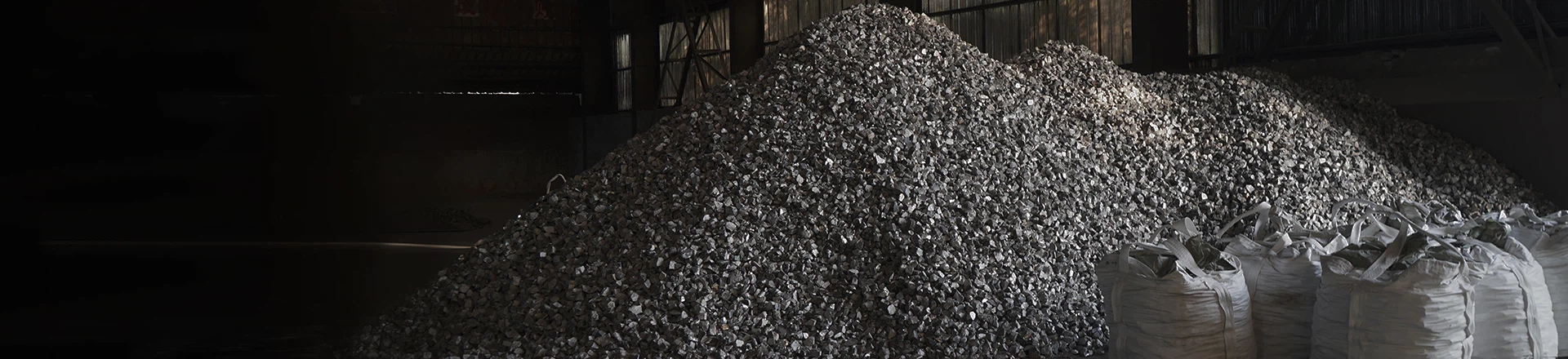
Silicon plays a crucial role in cast iron, mainly by promoting graphitisation to improve mechanical properties. Its role varies between the two main types of cast iron: ductile cast iron and grey cast iron. Here's how silicon metal is used in these applications:
2.1 Ductile cast iron
In ductile cast iron, silicon metal not only acts as a deoxidising agent but also acts as a graphitising element. It promotes the transformation of carbon from the carburite (Fe₃C) form to spheroidal graphite, which enhances the mechanical properties of the cast iron, such as toughness and ductility. Spheroidal graphite is distributed in the cast iron in the form of fine spherical shapes, which gives the cast iron not only high strength and hardness, but also retains a certain degree of ductility. Typical spheroidal graphite cast iron has a silicon content of between 2.2% and 2.8%
.
Promotes spheroidal graphite formation: Silicon metal helps the carbon to precipitate as spheroidal graphite rather than as carburite, and this spheroidal structure effectively reduces stress concentrations and improves the cast iron's impact resistance.
Improve toughness and ductility: The addition of silicon metal makes ductile iron have better toughness and ductility while maintaining high strength, which is suitable for mechanical parts with high strength requirements.
2.2 Grey cast iron
The main role of silicon metal in grey cast iron is to promote graphitization, so that carbon is precipitated in the form of flake graphite, which improves the mechanical properties of cast iron. Flake graphite is distributed in the matrix, forming a grey cast iron with good lubricity and vibration damping properties. Grey cast iron is usually used in the manufacture of engine blocks, valves and pumps and other mechanical parts. The silicon metal content of grey cast iron usually ranges from 1.5% to 3.5%.

Promotes flake graphite precipitation: Silicon metal encourages the precipitation of carbon in the form of flake graphite, which gives the cast iron good lubricity, which is important for reducing wear and prolonging the life of parts.
Improved vibration damping: The flake graphite structure gives grey cast iron good vibration damping properties, making it suitable for use in parts that need to absorb vibration and shock.
Summary
Silicon metal is a key element in cast iron and improves the properties of both ductile and grey cast iron by promoting graphitisation. The silicon metal content in ductile cast iron causes carbon to precipitate as spheroidal graphite, which improves the strength, toughness and ductility of the cast iron, while the silicon content in grey cast iron encourages carbon to precipitate as flake graphite, which enhances the lubricity and vibration damping properties of the cast iron. These roles make silicon indispensable in the manufacture of cast iron, widely used in the production of various mechanical parts.


