

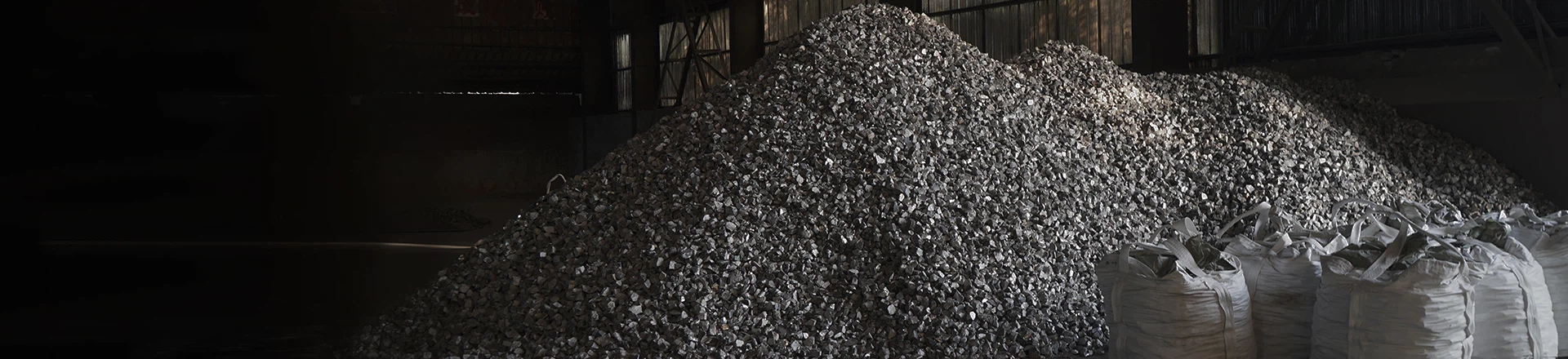


Ferro Chrome
1. High quality products
We adhere to the use of high-quality raw materials and adopt advanced technology and strict quality control to ensure that the supplied ferroalloy products meet international standards and customer needs.
2. Fast delivery
We have a strong supply chain and logistics network that can deliver products to customers in the shortest possible time and provide timely tracking services to ensure that customer needs are met.
3. Personalized customization
We can customize production and packaging according to the specific needs of our customers, to meet the needs of various applications and markets, and provide the best solutions for our customers.
4. Professional team support
We have an experienced and technically proficient team that can provide customers with comprehensive technical support and consulting services, answer various questions, and provide professional opinions.
5. Sincerely follow customers
We respect the needs and opinions of our customer wholeheartedly serve them, and establish long-term cooperative relationships to become a trusted supplier for our customers.
What is Ferro Chrome?
Ferro chrome is an alloy material consisting of chromium and iron, with chromium content typically ranging from 50% to 70%. Ferrochrome has high hardness and toughness, allowing it to maintain its properties and stability at high temperatures, thereby retaining high strength and hardness even in high-temperature environments. Additionally, ferrochrome exhibits outstanding corrosion resistance, making it capable of withstanding oxidation, acidic, and alkaline environments. Consequently, it finds extensive application in various corrosion-resistant equipment and structures.


Advantages of Ferro Chrome
Corrosion Resistance
Chromium, the primary component of ferrochrome, enhances the corrosion resistance of steel. Stainless steel produced with ferrochrome resists rust, tarnish, and corrosion, making it ideal for applications in harsh environments, such as marine and chemical processing.
Durability and Strength
The presence of chromium contributes to the hardness and strength of stainless steel. Ferrochrome enables the production of steel with excellent mechanical properties, making it suitable for a wide range of industrial and structural applications.
Heat Resistance
Stainless steel containing ferrochrome exhibits high-temperature strength and heat resistance. This property makes it valuable for applications involving exposure to elevated temperatures, such as in the manufacturing of industrial furnaces and exhaust systems.
Types of Ferro Chrome
Charge Chrome
Charge chrome is a category of HCFeCr developed primarily to utilize lower grades of chromite ores with a lower Cr/Fe ratio. As such these alloys typically contain lower levels of chromium (48-52%) compared to High Carbon Ferrochrome (52% and above). Due to the reduction kinetics the silicon levels are also typically higher in Charge chrome running at 4 – 6 %.
These alloys are commercially important to steel and stainless steel producers that utilize Argon oxygen decarburization (AOD) and similar technology in that it allows cost effective addition of chromium units while still being able to maintain low carbon levels. Almost all charge chrome produced is utilized in these sectors as this alloy is not suitable for use in most foundry alloys, primarily due to the higher Si levels.
High Carbon Ferrochrome
High carbon ferrochrome (HCFeCr) is mainly produced by reduction of chromite ores by carbon in Submerged Arc Furnaces (SAF). The produced alloys contain 50-75% Cr depending on ore composition, around 1-2 % Si and about 8-9%C typically. South Africa HCFeCr has a lower Cr content of 50-53 % compared to that produced in other parts of the world which have a 60+ % Cr content. This is due to the lower Cr:Fe ratio found in South African chromite ore.
Mineral-loy supplies an excellent quality HCFeCr which yields high chrome recovery in the melt and will provide a consistent Cr:C ratio. Each batch undergoes a stringent quality inspection which has made Mineral-Loy a supplier of choice for HCFeCr.
Medium Carbon Ferrochrome
Medium carbon ferrochrome (MCFeCr) is produced by further refining of charge chrome. The silicon in the product is reduced to below 1.5 %, and carbon is reduced to less than 2 % Max. The process takes place in a convertor where the liquid charge chrome is bottom blown by oxygen and steam to reduce the carbon content. The final product, an intermediate carbon ferrochrome, is produced in either a granulated or lumpy form. Mineral-loy supplies MCFeCr with a proven record of quality. It is available in bulk bags, bulk or any other bespoke packaging requirement. Specification and sizing can be found on the Mineral-Loy website or upon request.
Low Carbon Ferrochrome
The production of Low carbon ferrochrome combines charge chrome, quartzite and reductants in a SAF to produce ferro-silicon-chromium (FeSiCr) in a dry or slag-free process. The ferro-silicon-chrome contains low carbon content which is generally 0.1 % maximum.
Industrial Application of Ferro Chrome
Ferro chrome finds a range of industrial applications due to its unique properties, particularly in imparting corrosion resistance, strength, and durability. Some notable industrial applications of ferrochrome include:
● Stainless Steel Production
● Aerospace Industry
● Chemical and Petrochemical Industries
● Energy Industry
● Medical Instruments
● Mining and Ore Processing Equipment
● Railway Infrastructure
● Environmental Applications
The diverse applications of ferrochrome underscore its significance across various industries, where its unique combination of properties addresses specific engineering and operational requirements. The ongoing development of technologies and processes continues to expand the range of industrial applications for this essential alloy.

What Is the Raw Material for Ferro Chrome Production?
The primary raw material for ferro chrome production is chromite ore, a mineral containing chromium oxide (Cr2O3). Mined from chromite deposits, this ore undergoes beneficiation processes to remove impurities. In electric arc furnaces, carbonaceous materials like coke or coal serve as reducing agents during the smelting of concentrated chromite.
This smelting process results in the reduction of chromite to ferrochrome, an alloy of iron and chromium. During this stage, alloying elements like silicon, aluminum, and manganese can be added to achieve specific properties in the final alloy. The careful selection and processing of chromite ore are essential to achieving the specific properties required in ferrochrome, which is a vital component in the production of stainless steel and other corrosion-resistant alloys.
Properties of Ferro Chrome
Cr is resistant to common corrosive agents at room temperature, and is hence a fundamental constituent element for stainless steel. It also promotes the hardening of steels and the homogenization of this feature. Cr improves the heat resistant property of the steel. It may react with some acids with the evolution of hydrogen (H2). It can react with fused alkali with the formation of compounds containing hexavalent Cr. Cr has got a body centered cubic (bcc) crystal structure.
Fe-Cr is a solid which is available in a variety of forms, including small crystals, lumps and granules as well as in powder form. Its colour varies from dark metallic gray to light gray. It is odourless. It is not soluble in water. The dust particles of Fe-Cr alloy are combustible.
Chemical formula of ferro-chrome is FeCr. CAS number of Fe-Cr is 11114-46-8. The density for Fe-Cr varies in the range of 6 grams per cubic centimeters to 9 grams per cubic centimeters depending on its composition. The bulk density of Fe-Cr varies in the range of 3.3 grams per cubic centimeters to 3.7 grams per cubic centimeters. Its melting point is greater than 1500 deg C and boiling point is in the range of 2700 deg C to 3000 deg C.
Exposure to Fe-Cr can cause certain health problems. It can cause irritation to the skin. Contact of Fe-Cr with the eyes causes swelling and redness. Inhaling of Fe-Cr can result in coughing and irritation of the respiratory tract.
Fe-Cr is chemically stable under normal ambient and anticipated storage and handling conditions of temperature and pressure. It is neither classified as hazardous nor is classified as a hazardous good for its transportation.
Ferro Chrome Chemical Composition
The chemical composition of ferro chrome can vary depending on the specific grade and the intended industrial application. The percentage of chromium in ferro chrome typically ranges from 50% to 70% or more, depending on the grade. The carbon content is another significant factor, with high carbon, medium carbon, and low carbon ferrochrome grades available. Other alloying elements may include silicon (Si), aluminium (Al), and manganese (Mn), among others, depending on the specific requirements of the alloy being produced.
Physical Properties of Ferro Chrome
The physical properties of ferro chrome are listed in the table below:
|
Property |
Value/Description |
|
Color |
Silver to steel-gray |
|
Density |
6.7 – 7.2 g/cm³ (approximate range) |
|
Melting Point |
> 1,500°C |
|
Odor |
Typically odorless |
|
Hardness |
Influenced by chromium content, generally hard |
|
Magnetic Properties |
Magnetic, influenced by iron content |
|
Brittleness |
May exhibit brittleness, influenced by composition |
|
Electrical Conductivity |
Good electrical conductivity |
Production Process of Ferro Chrome
The production of ferro chrome involves a complex smelting process, usually carried out in electric arc furnaces. The process converts chromite ore (composed mainly of chromium oxide)) into ferro chrome, an alloy of iron and chromium. Here is a simplified overview of the ferrochrome production process:
Mining and Beneficiation
Chromite ore is mined from deposits, and the ore undergoes beneficiation processes to remove impurities. The beneficiation process can include crushing, screening, and gravity separation to concentrate the chromite.
Smelting
The concentrated chromite ore is then subjected to smelting in electric arc furnaces. These furnaces reach extremely high temperatures. Carbonaceous materials such as coke or coal are used as reducing agents. The carbon reacts with the oxygen in the chromite ore, reducing it to ferrochrome. The overall chemical reaction can be represented as:
Alloy Formation
The reduction of chromite results in the formation of molten ferrochrome, which collects at the bottom of the furnace. Other alloying elements, such as silicon, aluminum, and manganese, may be added at this stage to achieve specific properties in the final alloy.
Tap Hole and Casting
Once the furnace achieves the desired composition, it taps the molten ferrochrome through a tap hole.Afterwards, cast the alloy in its molten state into molds to solidify into the required shape for further processing.
Crushing and Screening
Crush and screen the solidified ferrochrome to produce various size fractions. The resulting product can be in the form of lumps, chips, or fines.
Cooling and Handling
The crushed and screened ferro chrome is then cooled to ambient temperatures and prepared for transportation or storage.
Difference Between Ferro Chrome and Chrome
Properties
The critical difference between Ferro Chrome and Chrome lies in their composition and properties. Ferro Chrome generally comprises 60-70% chromium, and 6-8% carbon, while Chrome contains at least 90% chromium. Ferro Chrome is much more heat resistant than Chrome and has higher tensile strength and hardness. On the other hand, Chrome is more corrosion-resistant and has excellent reflectivity and shine.
Uses in Industry
As mentioned before, Chrome is mainly used for decorative purposes, while Ferro Chrome is used for manufacturing steel alloys. Chrome is used in the automotive industry for decorative trim, wheels, and bumpers, as well as in the aerospace industry for parts that require high corrosion resistance. In contrast, Ferro Chrome produces stainless steel, tool steel, and other specialized alloys that require high corrosion and heat resistance levels.
Choosing the Right One
Choosing between Chrome and Ferro Chrome depends on the intended use and application. If you need a metal that is highly resistant to corrosion and has a high level of shine, then Chrome is the right choice. However, if you need a metal that can withstand high temperatures and is highly durable, then Ferro Chrome is the way to go. Considering the intended application and the properties required before choosing is essential.
Other Differences
● Ferro chrome is an alloy of chromium and iron, while Chrome is simply chromium.
● Ferro chrome produces stainless steel, while Chrome is used for plating and finishing.
● Ferro chrome contains 60-70% chromium, while Chrome contains 24-46%.
● Ferro Chrome is more expensive than Chrome due to its higher chromium content.
● Ferro chrome is more corrosion-resistant than Chrome due to its higher chromium content.
Medium, low and micro-carbon ferrochromium generally uses silicon-chromium alloy, chromite and lime as raw materials, and is refined and desiliconized with a 1500-6000 kVA electric furnace, and is operated with high basicity slag (CaO/SiO2 is 1.6-1.8). Low and micro-carbon ferrochromium is also produced on a large scale by the hot mixing method. During production, two electric furnaces are used, one for smelting silicon-chromium alloy, and the other for melting slag composed of chromium ore and lime. The refining reaction is carried out in two buckets in two stages: ① After the slag of the slag furnace is injected into the first bucket, the silicon-chromium alloy that has been initially desiliconized in the other bucket is added. The amount is very large, and the desiliconization is sufficient, and the micro-carbon ferrochromium with a silicon content of less than 0.8% and a carbon content of as low as 0.02% can be obtained. ②After the slag (containing about 15% of Cr2O3) after the reaction in the first bucket is moved to the second bucket, the silicon-chromium alloy (containing 45% of silicon) made by the silicon-chromium electric furnace is heated into the slag to react. After that, the silicon-chromium alloy (containing about 25% silicon) that has been initially desiliconized is obtained, which is mixed into the first ladle for further desiliconization, and the slag containing Cr2O3 less than 2-3% can be discarded.
Refining medium and low carbon ferrochromium by oxygen blowing method, using liquid carbon ferrochromium as raw material, adding a small amount of lime and fluorite to the molten pool during blowing to make slag, and adding silicon-chromium alloy or ferrosilicon before tapping to recover the slag. chromium. The blowing of micro-carbon ferrochromium is only possible under a certain degree of vacuum.
Refining by vacuum solid-state decarburization method, using ground high-carbon ferrochrome as raw material, part of the ground high-carbon ferrochrome is oxidized and roasted as an oxidant, mixed with water glass or other binders, pressed into agglomerates, and subjected to low temperature After drying, in a car-bottom vacuum furnace, heating and reducing at a vacuum degree of 0.5-10 mmHg and a temperature of 1300-1400 °C for 35-50 hours, micro-carbon with a carbon content of less than 0.03% or even less than 0.01% can be obtained. Ferrochrome.
Ferro Chrome Market Drivers
Construction industry is the major end-use sector of stainless steel, accounting for more than 50 percent of steel consumption. Structures like houses, skyscrapers, bridges, tunnels, and more rely on steel for their strength. Residential, non-residential and new infrastructure projects, such as bridges and airports, railway stations along with the growth of commercial/industrial businesses are driving the need for high-strength steel.
Machinery cover a wide range of equipment from small workshop tools to large factory-based robotic machinery and rolling mills which are used across various industries that includes construction equipment such as cranes, drills, bulldozers, scaffolding, and reusable and portable shelters used on construction sites. Steel is essential in our modern world. Products around us are either made of steel or made from a machine made of stainless steel. It is estimated that approximately 14 % of global steel is used to making machinery. Machinery manufacturing is one of the largest, complex, and most competitive sectors, which require a wide range of objects with diverse requirements to face present tougher challenges. Ferrochrome when used for the manufacturing steel offers the end product with reduced risk to be susceptible to corrosion as well as increases the overall tensile strength of the end product. Therefore, the use of Ferrochrome in manufacturing stainless steel has increased because of the rising demand for high-strength steel from machinery tools. According to the world steel association, the production of steel is increasing every year and is expected to continue in the coming years.
Certifications


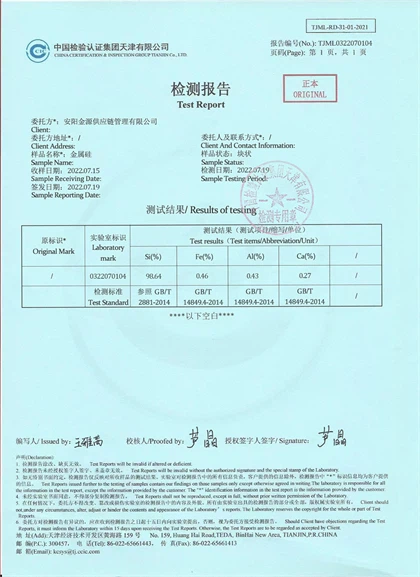
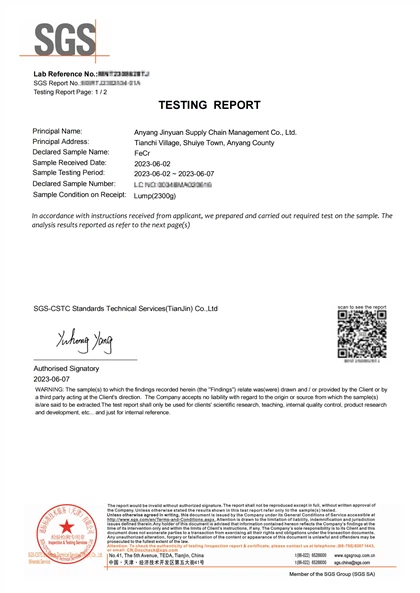
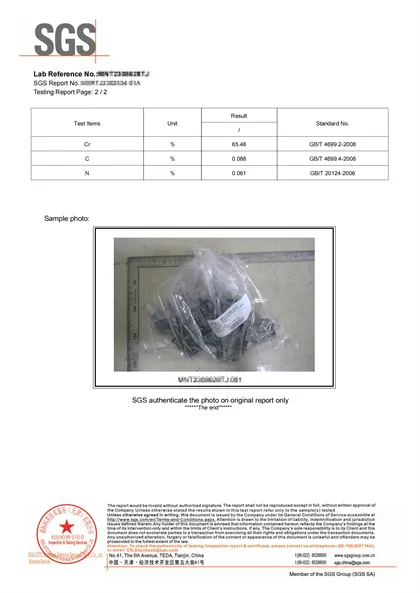

Anyang Jinyuan Supply Chain Management co., Ltd was established in 2021s. It covers an area of 30,000 square meters, with registered capital of 1,638,880 dollars, liquid capital of 6million dollars and annual sales of 16 million dollars. We are capable of researching and developing new products independently. For the past years, we have produced many new and special products for clients of steel mills and foundry industries, which satisfy our clients and help us enjoy good comments and higher praise.

Ultimate FAQ Guide to Ferro Silicon
Q: Why is ferro chrome so expensive?
Q: What is the future of ferrochrome?
Q: Is ferro chrome magnetic?
Q: How much electricity does ferrochrome use?
Q: What are the raw materials for ferro chrome?
Q: Where is ferrochrome from?
Q: What is the difference between ferro chrome and ferro manganese?
Q: What is ferro chrome lumpy?
Q: What is the melting point of ferro chrome?
Q: How do they make ferrochrome?
Q: What is low carbon ferro chrome used for?
Q: What is ferrochrome slag?
Q: How do you make low carbon ferro chrome?
Q: Which is stronger chrome or steel?
Q: What is high carbon ferro chrome used for?
Q: What is the difference between ferro chrome and chrome?
Q: What is the difference between ferrochrome and chrome ore?
Q: What is the structure of ferrochrome?
Q: What is the chemical composition of low carbon ferro chrome?
Q: Is ferro chrome a metal?